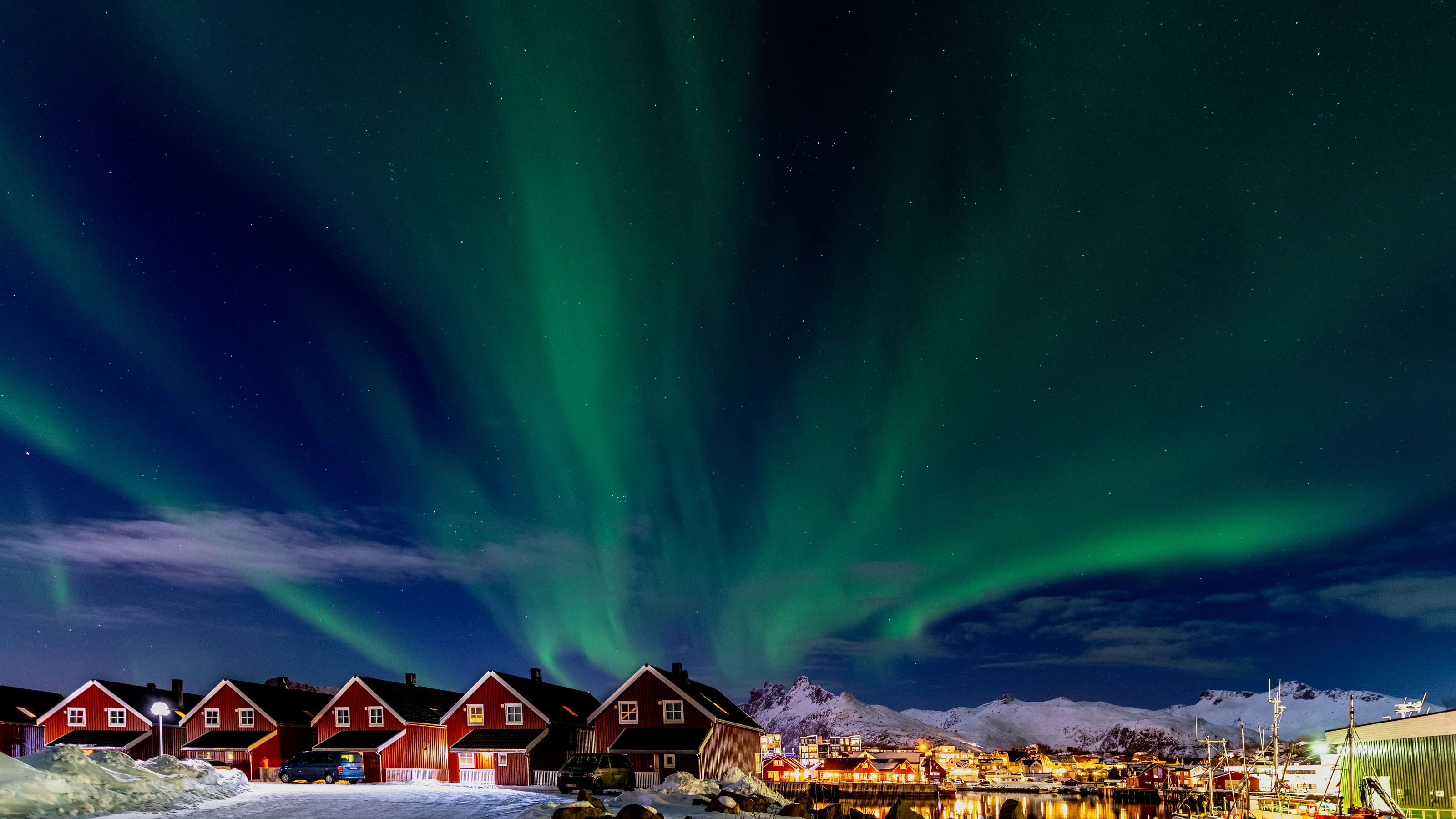
Lofoten after dark · Tours & places to stay
Northern lights in Lofoten: when to go and what to book
Plan for dark nights from late August to mid-April, allow several evenings, and choose accommodation you will enjoy even if the sky stays cloudy. A guide helps with the search; a sighting is never guaranteed.
Photo credits
When can you see the northern lights in Lofoten?
Visit Lofoten gives the viewing season as late August to mid-April. The practical requirements are darkness, enough clear sky and auroral activity. Summer’s bright nights make this the wrong destination for a June or July trip whose main purpose is seeing the lights. A dark month provides opportunity, not certainty.
September is the first period we would compare for a trip that also includes daytime sightseeing. February or March is worth considering if winter scenery is part of the appeal and you are comfortable planning for winter conditions. Those are editorial trip choices, not claims that a particular month has the highest measured chance of a sighting. Keep several evenings available instead of making one night carry the entire trip.
Where to see the northern lights: three areas to compare
Start with the weather near your base. These places offer different horizons, so choose for the direction of the display and the cloud cover that evening. Our area choices are practical starting points, not a ranking of measured sighting rates. Use signed parking, keep away from breaking waves and inspect your access in daylight.
| Area | Why consider it | What changes the decision |
|---|---|---|
| Uttakleiv, Vestvågøy | An open northern horizon for displays low in the sky | Mountains limit other directions; parking and visitor facilities are paid |
| Haukland or Vik, Vestvågøy | Views towards the west and southwest | Consider these when the display shifts away from the northern horizon |
| Hov, Gimsøy | A northern coastal setting, also used for guided aurora riding | Arrange transport and use public access; the beach and nearby businesses have different facilities |
Our recommendations
Two guided tours and a practical base
Compare the actual operator, meeting point and group conditions. The landscape photos illustrate Lofoten; they are not a record of what a particular departure will see.
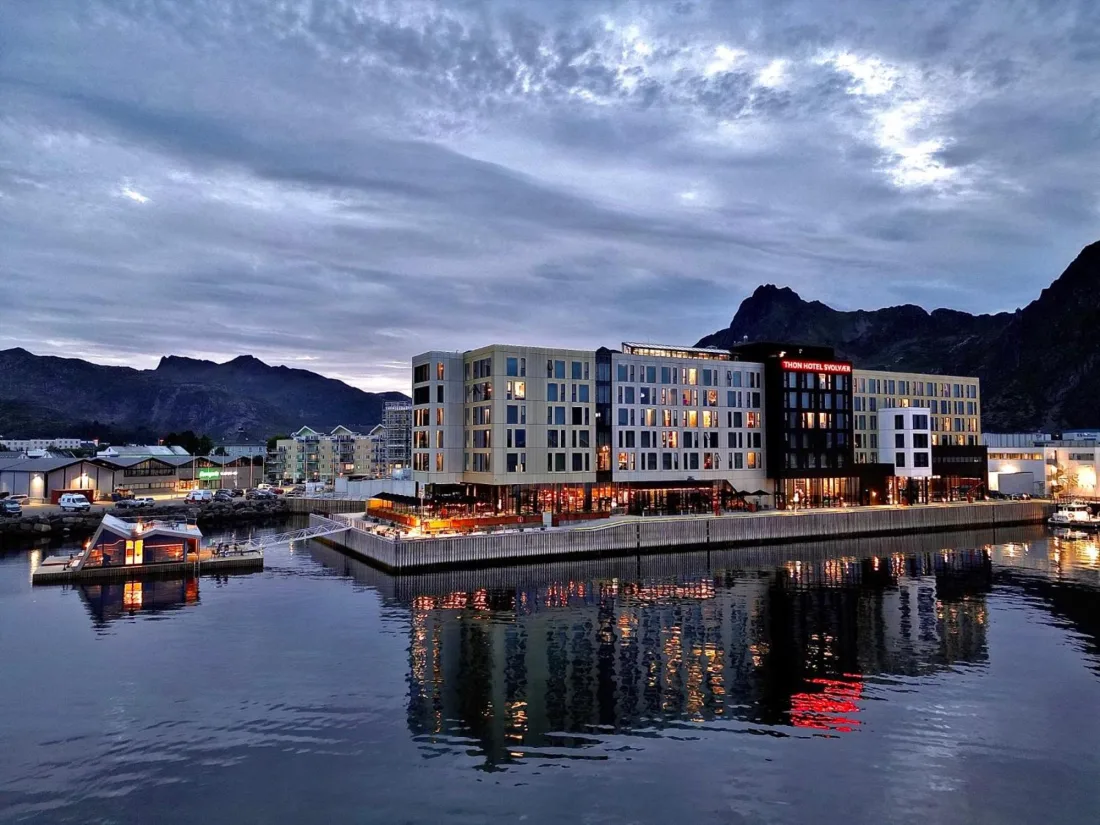 For a Svolvær base
Thon Hotel Svolvær · Property photograph
Thon Hotel Svolvær
- Svolvær
- Hotel stay
- Book tours separately
A practical hotel to compare when taking an evening tour from town. Confirm the meeting point and plan an easy return after a late night.
Check prices and availabilityHotels.com · Affiliate link
Read why we chose itEnter your dates and check the final price and booking conditions.
Which booking fits your evening?
- For a small-group evening
RAW Lofoten: northern lights tour
- Type
- RAW Lofoten tour
- Duration or location
- 4½ hours
- Check first
- Svolvær Torg; minimum age 10
- For photography support
Lofoten Lights: photographer tour
- Type
- Lofoten Lights tour
- Duration or location
- 4 hours
- Check first
- Pickup and group size on your date
 For a Svolvær base
Thon Hotel Svolvær
- Type
- Hotel, booked separately
- Duration or location
- Svolvær
- Check first
- Distance to the tour meeting point
Check prices and availabilityHotels.com · Affiliate link
For a small-group evening
RAW Lofoten — a small-group tour from the square
The current RAW Lofoten listing describes a 4½-hour tour for up to seven guests, with English or Norwegian guiding. It meets at Svolvær Torg outside the visitor information office and is not suitable for children under ten. Hot drinks and photography help are part of the published offer.
This is our first comparison for travellers who value the stated group limit and a clear central meeting point. Have an early dinner, wear warm layers and keep the following morning relaxed. Read the cancellation terms for the date you select. An operator cancelling for unsafe weather and a tour running without visible aurora are different situations; do not assume the latter automatically means a refund.
For photography support
Lofoten Lights — when photography is the priority
Lofoten Lights offers a four-hour photographer-led tour in English. Its listing describes pickup arrangements and help with photographs. Although the normal group is described as up to eight, the same listing allows larger groups, up to fifteen, during busy periods or weather-related rescheduling.
That distinction matters if a small group is essential to you. Compare the confirmed pickup location and expected group arrangement before choosing this over RAW Lofoten. Photography support is useful for understanding your equipment and making the most of a brief display; it does not give the guide control over cloud cover or solar activity.
For a Svolvær base
Where to stay: make the late-night logistics easy
A Svolvær hotel is a practical base when joining tours that depart from town. Thon Hotel Svolvær is one option to compare, while the full Svolvær hotel guide also covers the town-square hotels and self-catering alternatives. Check the meeting point for your chosen tour before deciding how convenient the hotel is.
A room with a view can be enjoyable, but do not pay for a supposed northern-lights room on the assumption that it guarantees a display. Building orientation, outside lighting, cloud and the actual aurora all matter. If you stay around Reine or Hamnøy, choose a locally suitable outing or arrange transport explicitly rather than casually adding a late return from Svolvær.
Check prices and availabilityHotels.com · Affiliate link
Guided tour or your own search?
A guided tour can remove the burden of choosing a route and driving unfamiliar roads after dark. That is especially useful for visitors who do not want to combine tiredness with winter driving. Compare the time spent travelling, the meeting arrangements and the operator’s weather policy with what you would realistically do alone.
If searching independently, start with a safe, lawful place near your accommodation where you can see a broad area of sky. Do not stop in a traffic lane, use a bridge as a waiting area or walk into someone’s garden for a darker foreground. Identify your access and return route in daylight. A distant beach is not automatically a better choice if getting there introduces an avoidable driving risk.
How to use the forecast without chasing a number
Check the ordinary weather forecast first: cloud cover and wind can decide whether you can observe comfortably at all. Then use an aurora forecast as another planning input. A promising activity forecast behind thick cloud may be less useful than a quieter display visible through a clear patch.
Recheck conditions before leaving and keep your evening flexible. Do not turn one forecast number into a promise or drive across the islands simply because an app changes colour. If a guide changes the route, ask about the expected duration and return arrangements so you can decide whether the revised evening still fits your plans.
Getting a photograph you will want to keep
Bring a charged phone or camera, spare power and a stable support if your equipment needs one. Learn how to activate night mode or manual controls indoors before the trip. Use a timer to reduce movement and start with short test exposures; a long exposure may record colour that looks subtler to your eyes.
Put the camera away for part of the display. Bright screens and lights can disturb other people, so keep them low and use a headlamp considerately. Gloves that let you operate the controls and a dry place for spare batteries are often more useful than carrying a heavy bag of lenses.
Make a good trip even when the sky does not cooperate
Choose daytime activities and accommodation on their own merits. A village walk, a meal, a museum or a boat trip can make the day worthwhile without requiring a successful aurora hunt. Keep at least one evening with no late commitment so you can rest rather than repeating the same exhausting search every night.
For a week-long holiday, our Lofoten itinerary can be adapted by replacing summer hikes with suitable seasonal outings. Do not copy the hiking days unchanged into a winter trip. Book the experience you will enjoy, with a possible northern-lights display as the highlight rather than the only measure of success.
Questions & answers
Can I see the northern lights in Lofoten in summer?
The bright nights of June and July are unsuitable for a northern-lights trip. The local tourism guidance places the viewing season from late August to mid-April.
Does a guided tour guarantee a sighting?
No. Guides can respond to weather and choose viewing locations, but they cannot guarantee clear sky or visible aurora.
How many nights should I allow?
We suggest several nights so you have more than one possible evening. This improves flexibility but is not a guarantee or a measured probability.
Is Svolvær a useful base?
Yes, particularly for tours departing from town. Confirm the exact meeting point or pickup location; accommodation and tours are separate bookings.
Will I get a refund if no northern lights appear?
Only if that is part of your chosen booking conditions. Weather cancellation by an operator and an operating tour without a sighting are not the same circumstance.
Sources & editorial approach
Selected by ViewLofoten for location, practical differences and fit with the itinerary, using published information from the providers. Compare the exact room, vehicle or departure before booking. Prices, availability and conditions depend on your dates.
Photo credits
Resized, cropped for the layout and converted to WebP.